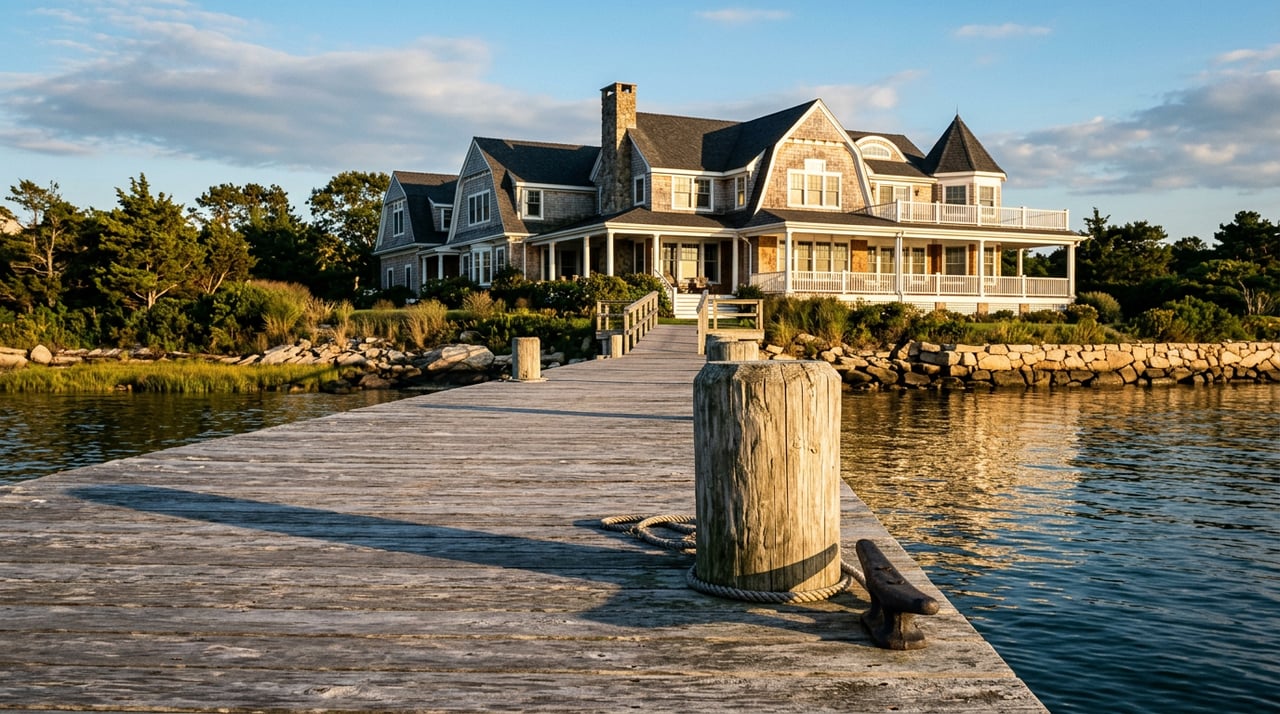
Picture two nearly identical Cape Cod properties. Both built in the same decade, both with septic systems in good working order, both carrying a clean Title 5 inspection report dated within the last year. One buyer closes and moves on with no further obligation to the system underground. The other inherits a mandatory upgrade that will cost tens of thousands of dollars, not because anything is wrong with the tank or the leach field, but because of a line on a watershed map that has nothing to do with how well the system currently functions.
That is the mechanism most buyers on the Cape do not understand until it is too late to price it into an offer. A passing Title 5 certificate tells you a septic system works today. It says nothing about whether the state has already decided that system needs to be replaced within a matter of years for reasons entirely outside the seller's control, and entirely outside the inspector's scope.
What a Title 5 Certificate Actually Certifies
A Massachusetts Title 5 inspection answers one question: does this system, as built and as maintained, currently protect groundwater and public health under the state's operating standards. The inspection has to happen within two years of the property changing hands, and the resulting report stays valid for two years, or three if the system has been pumped annually. Pass that inspection and, under the traditional reading of Title 5, you are done.
Since July 2023, that has stopped being the whole story for a large share of Cape Cod. The Massachusetts Department of Environmental Protection finalized regulations that year creating a new category layered on top of the old pass-fail standard: the Natural Resource Area, a designation applied to watersheds feeding estuaries and embayments that the state has determined are being degraded by excess nitrogen, most of it originating from septic systems. A property inside one of these zones can have a spotless inspection report and still face a state-mandated upgrade to what the regulations call Best Available Nitrogen Reducing Technology. The inspection and the designation are separate questions, and only one of them shows up on the paperwork a buyer typically sees before closing.
The Regulatory Clock That Started Running in 2023
The way the rule is built, every affected town faces a choice. A town can apply for a Watershed Permit, which lets it pursue nitrogen reduction at the community level through sewer expansion, aquaculture, fertilizer restrictions, or other tools, in exchange for keeping individual homeowners in that watershed exempt from the mandatory upgrade requirement. Or a town can decline to pursue that permit, in which case every affected homeowner in the designated area becomes individually responsible for upgrading their own system.
Towns had until roughly the middle of 2025 to commit to the Watershed Permit path. Where that commitment did not happen, the individual upgrade obligation carries an effective deadline landing around 2030. MassDEP's own estimate puts the cost of that upgrade at $25,000 to $35,000 per system, with the state itself noting the real number can run higher depending on site conditions.
None of this is optional information a seller can choose to leave out. Both Chapter 93A and the Title 5 regulations themselves require disclosure of a property's Natural Resource Area status before any transfer of title takes place. If a parcel sits inside a designated zone, that fact has to be on the table before an offer becomes a closing.
Why the Same Street Can Split Two Ways
The watershed lines that define these zones do not follow property boundaries or town lines. They follow water. Two houses across a pond from each other, or two houses on the same street with a drainage divide running between their lots, can fall on opposite sides of a Natural Resource Area boundary. One owner faces the upgrade timeline. The other does not.
Layered on top of that is each town's own sewer expansion schedule, which is its own patchwork. Barnstable, the town that contains Osterville, Cotuit, and Hyannis Port, is well into Phase 1 of its Comprehensive Wastewater Management Plan. That phase is projected to add roughly 90 miles of new sewer infrastructure and remove approximately 44% of the nitrogen the town's plan targets. The Route 28 West project is currently under construction, and the Phinney's Lane Neighborhoods expansion is scheduled to run from fall 2026 through fall 2029. A property that falls inside that mapped phase is on a defined, funded timeline toward sewer connection. A comparable property two streets outside that boundary may be waiting on a phase that has not been scheduled at all.
Here is how that plays out across the towns most relevant to a Cape Cod buyer weighing waterfront or near-water options this year:
| Town (villages) | Where things stand as of mid-2026 | What it means for a buyer |
|---|---|---|
| Barnstable (Osterville, Cotuit, Hyannis Port) | Phase 1 targets about 90 miles of new sewer and roughly 44% of the town's nitrogen-reduction goal. Route 28 West is under construction; the Phinney's Lane expansion runs fall 2026 through fall 2029. | Being inside Phase 1's mapped area puts a property on a funded, dated path to sewer connection. Outside that boundary, the timeline is undetermined. |
| Falmouth | The Great Pond Phase 1 Sewer Project, backed by roughly $60 million appropriated in 2025, moved into construction in 2026. A separate ocean outfall project would discharge treated wastewater about 2,300 feet into Nantucket Sound. | Great Pond Phase 1 is one piece of a larger concept intended to eventually reach around 1,800 parcels across the Teaticket-Acapesket watershed. Proximity to the pond does not by itself mean current-phase coverage. |
| Mashpee | Phase 2 of the town's sewer program began construction in December 2025 and is expected to finish in spring 2028, covering about 1,200 properties and six pump stations. | A useful benchmark for buyers cross-shopping Barnstable villages against a neighboring town running its own separate, differently timed buildout. |
What the Escape Valve Actually Costs
Sewer connection is often framed as the clean alternative to an individual septic upgrade, and in a straightforward sense it is. But it is worth being precise about what "the sewer is coming" actually promises. Falmouth's $60 million Great Pond investment is real and under construction, but it is sized to serve a defined Phase 1 area within a watershed the town eventually hopes to cover more fully. A listing agent's mention that "sewer is planned" for a neighborhood is not the same claim as a parcel sitting inside a funded, scheduled phase.
The money behind these projects is substantial and growing. The Cape Cod and Islands Water Protection Fund approved roughly $53.1 million in April 2026 alone across ten wastewater projects spanning Barnstable, Dennis, Eastham, Mashpee, and Yarmouth, and has committed more than $360 million to Cape wastewater work since 2018. That fund draws in part on a 2.75% excise tax applied to lodging and short-term rentals on the Cape and Islands, which means visitors and seasonal renters are indirectly financing the same infrastructure that will eventually determine whether a given property connects to sewer or upgrades its own system. For an owner who rents seasonally, that is a detail worth knowing, not just a curiosity.
For homeowners who do face an individual upgrade, Barnstable County's AquiFund offers low-interest loans specifically for septic replacement and sewer connection costs, and the state's septic tax credit was increased for tax years beginning in 2023, reducing the after-tax bite of a mandatory system replacement.
What This Changes at the Negotiating Table
For a seller, the disclosure obligation means finding out a property's Natural Resource Area status before listing, not after an inspector or a buyer's attorney raises it during due diligence. For a buyer, the questions worth asking go beyond whether the Title 5 report is clean. Ask whether the parcel sits inside a designated Natural Resource Area. Ask whether the town has secured a Watershed Permit or filed a Notice of Intent to pursue one. Ask which phase of the town's sewer plan, if any, includes that specific address, not just the neighborhood in general terms.
These are not questions a standard home inspection answers, and they are not questions that show up on a listing sheet. They are questions that require knowing which town office to call, which map to pull, and which of two very differently worded planning documents actually applies to a specific parcel. On the Cape, that knowledge is often the difference between a smooth closing and a five-figure surprise two years into ownership.
A Few Direct Questions
Does a passing Title 5 report mean a property is safe from future septic costs? Not by itself. The inspection confirms the system works today. It says nothing about whether the parcel sits inside a Natural Resource Area facing a mandatory nitrogen-reducing upgrade regardless of current performance.
How do I find out if a specific property is in a Natural Resource Area? The town's Board of Health or wastewater program is the direct source, and MassDEP maintains a mapping tool that identifies designated zones by address. For a property already under agreement, this should be confirmed before the inspection contingency expires.
If a town has committed to a Watershed Permit, does that mean I'm in the clear? It means the individual upgrade mandate is currently waived for that watershed while the town pursues community-level solutions such as sewer expansion. It does not mean the underlying nitrogen problem, or the town's long-term wastewater costs, have disappeared.
Waterfront and near-water property on Cape Cod carries a layer of regulatory detail that a median price or a passing inspection will never surface on its own. Working through which watershed a specific address falls into, and which town commitments actually apply to it, is exactly the kind of groundwork that belongs in a serious offer, not an afterthought once the papers are signed. If you are weighing a purchase or a sale in Osterville, Cotuit, Hyannis Port, Falmouth, or elsewhere on the Cape, Robert Kinlin can walk through what a specific parcel's watershed status and sewer timeline actually mean for your decision. Let's Connect.