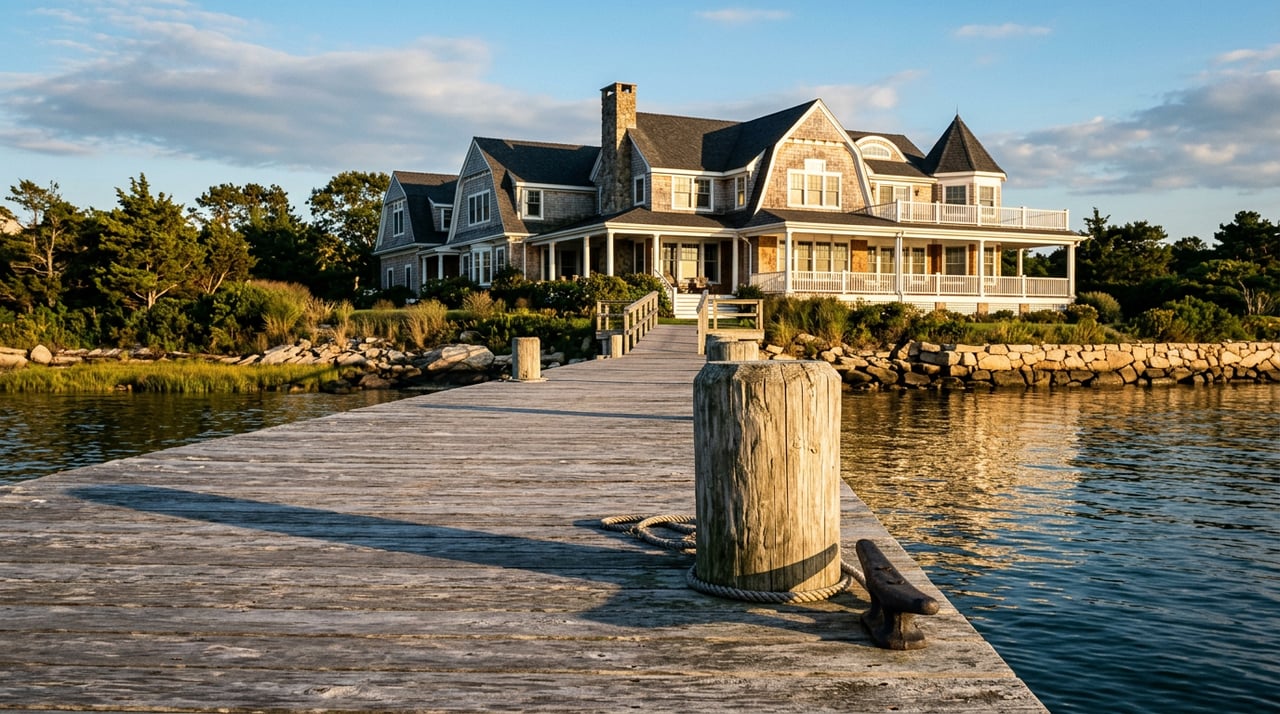
Two houses sit within sight of each other on the same finger of shoreline in Osterville. Both have four bedrooms, both were built within a decade of each other, both look out over calm water. One lists for meaningfully more than the other. The listing sheets don't explain why. The comps a buyer pulls from a portal don't explain why either. The answer is sitting in a filing cabinet at Barnstable Town Hall, in a piece of code most buyers never read until it's too late to matter: the house with the higher price has a permitted dock already in the water, and the other one doesn't, and under the town's current rules, that gap may not be something money can fix.
This is the conversation that catches Osterville buyers off guard more than almost anything else on the Cape. Not the price of the house. The presumption baked into the process of getting a dock approved once you own it.
The Sentence Every Dock Application Starts With
Barnstable's Conservation Commission regulates private docks and piers under a section of town code known as Chapter 703, and it does not start from neutral ground. Any project that alters a bank, salt marsh, tidal flat, or land under the ocean, which is to say almost any new dock or expanded pier, is presumed by the commission to have a significant adverse effect on those resources. The burden sits with the applicant to overcome that presumption, and the code is explicit that only a preponderance of evidence will do it.
That is a different starting point than most buyers assume when they see "dock potential" in a listing description. It means a homeowner proposing a new dock isn't asking the town for a routine sign-off. They're asking the commission to be convinced that their project is the exception to a rule written to protect eelgrass beds, shellfish habitat, and the tidal flats those species depend on.
The code adds more friction once you're past that first hurdle. No dock, even one otherwise approved, can be built until the house it serves has an occupancy permit, which matters for anyone buying a waterfront lot with the plan to build first and dock later. Materials are restricted too. Creosote-treated pilings are banned outright, lead caps aren't permitted, and only non-CCA lumber can go into new construction. A homeowner replacing a few rotted planks on a dock built in the 1980s is now working under a materials standard that didn't exist when the original structure went in.
Four Decisions, Two Decades, One Pattern
None of this is theoretical. The Conservation Commission's own project records and meeting minutes show how it plays out address by address.
| Year | Location | Proposal | Water Body | Outcome |
|---|---|---|---|---|
| 2005 | 16 Coddington Road, Centerville | New 204-foot walkway with stationary dinghy dock | Centerville River | Approved |
| 2009 | 186 Windswept Way, Osterville | Rebuild pier, rotate float, add ramp | Cotuit Bay | Denied |
| 2020 | 195 Seapuit Road, Osterville | Beach nourishment along the shoreline | Seapuit River corridor | Approved |
| 2022 | 521 Bumps River Road, Osterville | Filing to modify existing dock and pool area | Bumps River | Filed for hearing |
Read in sequence, the pattern isn't blanket refusal. The commission approved shoreline work at Seapuit Road and a straightforward new dinghy dock at Coddington Road years earlier, but a full rebuild that changes a dock's footprint, even one replacing something that was already there, gets treated as a fresh application subject to the full presumption. The 2009 denial at Windswept Way wasn't a new dock proposal. It was a request to rebuild, rotate the float, and add a ramp to a pier that predated the current standard, and the commission said no anyway. Even the more modest 2022 filing at Bumps River Road, which asked only to modify an existing dock and pool area, still had to go through a full Notice of Intent hearing rather than a routine sign-off.
That's the detail worth sitting with if you're evaluating a waterfront property with an aging dock. Owning a dock today doesn't guarantee you can rebuild it tomorrow on your own terms.
What Grandfathering Actually Buys You
The flip side of that friction is what it does to the value of a dock that already cleared this process years ago, under an Order of Conditions the town issued before today's standard existed. The code allows improvement dredging to restore a dock's original permitted depth, but not to deepen it beyond that. In effect, a grandfathered dock is frozen at its original specifications, and that freeze is exactly what makes it valuable. It's a structure that could not be built today, sitting in the water anyway, attached to a piece of land you're about to buy.
I've sold Osterville waterfront where the dock itself was the deciding feature for the buyer, not the square footage of the house. A property I represented on the water there carried a deep-water dock sized for six or more vessels, the kind of capacity that would require overcoming Chapter 703's presumption from scratch if someone tried to build it new today. Buyers who understand what that dock represents don't treat it as an amenity. They treat it as the asset the house happens to be attached to.
Inside Oyster Harbors, the private gated community on Grand Island, there's a second layer to account for. Beyond the town's Conservation Commission process, dock work also goes through the island's own governing association, which maintains a separate approval process for boats and dock changes on top of whatever Barnstable requires. A buyer there is clearing two gates, not one.
The Two Bays Aren't the Real Divide
Buyers researching Osterville tend to sort listings by which bay they sit on, West Bay for deep-water access to Nantucket Sound, or the quieter frontage along the Bumps River and Seapuit River. That's a real distinction for boating range and mooring depth. But it's not the distinction that explains why two houses on comparable lots carry different prices.
The real divide runs between properties with a permitted dock already in place and properties without one, regardless of which bay they're on. A house on the Bumps River with a grandfathered dock in reasonable repair is working from a stronger position than a West Bay property whose listing describes dock potential but has no Order of Conditions on file. The water body sets the lifestyle. The permit sets the ceiling on what you can build or rebuild there.
Before You Write the Offer
If a dock, existing or hoped for, is part of why you're drawn to a specific Osterville property, a few questions are worth answering before you're under contract rather than after.
- Ask the seller for the dock's Order of Conditions and confirm the current structure matches what was actually permitted, not a later addition.
- Check whether the dock predates the mid-2000s tightening of the code, since older approvals sometimes carry more generous footprints than anything issued today.
- If the listing describes dock potential rather than an existing structure, treat that as a proposal you'd be submitting, not a feature you're buying. The town's Conservation Division can tell you whether a Notice of Intent has ever been filed for that parcel.
- For anything in Oyster Harbors, ask about the association's own dock approval requirements in addition to the town's.
None of this is a reason to walk away from a waterfront property without a dock. It's a reason to price the uncertainty honestly rather than assume the next owner can simply build one.
A Few Direct Questions
Can I add a dock to an Osterville waterfront lot that's never had one? You can apply. Under Chapter 703, the commission starts from a presumption that the project will have an adverse effect on protected resources, and the burden is on you to show otherwise with a preponderance of evidence. Some applications succeed. None start from neutral ground.
Does a grandfathered dock transfer with the sale of the house? The physical structure and its existing Order of Conditions transfer with the property, but the specifications are frozen at whatever the original approval allowed. You inherit the dock as it was permitted, not a blank slate to modify.
If my dock just needs repair, is that easier than a new build? It's a different application, but not an automatic yes. Even a 2022 filing at Bumps River Road that asked only to modify an existing dock and pool area still required a full Notice of Intent hearing rather than a routine sign-off. A full rebuild that changes the float position or adds structure, as the 2009 Windswept Way case shows, can still draw a denial.
What materials can I use for repairs? Current standards prohibit creosote-treated wood and lead caps, and require non-CCA lumber. A dock built decades ago under older material standards may need updated materials even for routine maintenance.
Waterfront value on Cape Cod has always been about more than the view. In Osterville right now, it's about what's already been approved and what would have to be argued for from scratch. If you're weighing a waterfront purchase here, or wondering what a dock already in place is really worth to your plans, I'd welcome the conversation. Robert Kinlin: Let's Connect.